How to use Voice AI for healthcare market research
Learn four ways to use Voice AI technology to streamline your healthcare market research.



Healthcare runs on conversations — between patients and providers, clinicians and specialists, agents and callers. But most of that voice data disappears the moment the call ends, and with it, insights that could improve patient outcomes and reduce the operational burden driving clinician burnout. Below, we'll explore how Voice AI is changing that — from the core technologies to real-world use cases and how to build with it. It applies from hospital systems to veterinary practices, anywhere specialized medical vocabulary matters.
What is Voice AI for healthcare?
Voice AI in healthcare captures, transcribes, and analyzes spoken language from patient interactions in real time — turning conversations into structured, searchable, actionable data. It powers everything from clinical documentation and patient scheduling to screening, triage, and compliance workflows.
Unlike text-based chatbots that rely on typed input and scripted decision trees, Voice AI works with natural speech. Patients call, speak naturally, and get things done — scheduling appointments, completing intake forms, answering screening questions — without navigating phone menus or waiting on hold.
That distinction matters. In healthcare, where communication is nuanced, time-sensitive, and often emotional, the difference between chatbots and Voice AI isn't incremental — it's fundamental.
Core Voice AI technologies powering healthcare applications
Voice AI combines several core technologies into a pipeline that transforms raw audio into clinical and operational intelligence. Here's what powers it under the hood:
- Speech-to-text: The foundation of any Voice AI system. Speech-to-text models convert spoken language into written text with high accuracy — including medical terminology, drug names, and clinical abbreviations. In healthcare, accuracy isn't optional. A misheard medication name or dosage can have real consequences. Models like Universal-3 Pro are built to handle this complexity, and AssemblyAI's Medical Mode add-on reduces missed medical entities by roughly 20% versus Universal-3 Pro alone — catching drug names, dosages, and clinical terms that general-purpose models frequently get wrong.
- Speech understanding: Transcription alone isn't enough. Speech understanding extracts meaning from the text — identifying sentiment, flagging urgent topics, detecting clinical entities like diagnoses and procedures, and categorizing conversations by theme. For a healthcare contact center processing thousands of calls daily, this turns unstructured audio into structured insights without manual review.
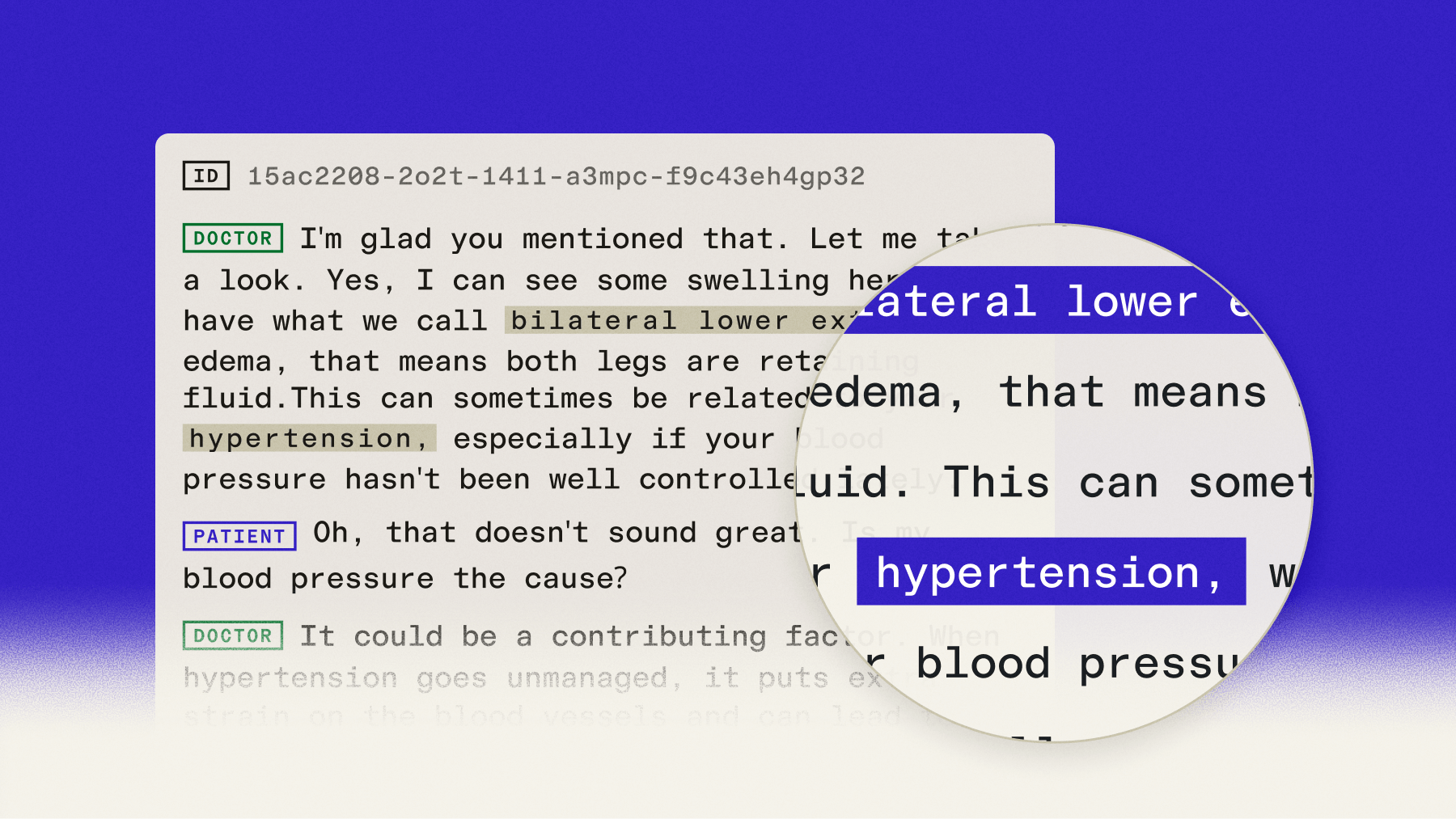
- Speaker diarization: In any clinical conversation, knowing who said what is critical. Speaker diarization identifies and labels individual speakers throughout a recording. For AI scribes documenting a visit, diarization separates the clinician's notes from the patient's responses — enabling accurate, attribution-correct documentation.
- LLM Gateway: Large language models applied to transcribed speech unlock a new layer of analysis. The LLM Gateway can automatically generate visit summaries, extract action items from care coordination calls, identify follow-up requirements, and draft structured clinical notes — saving hours of manual documentation work.
These technologies don't operate in isolation. In a voice agent workflow they form a pipeline: audio streams in, speech-to-text converts it to text, speech understanding extracts meaning, and an LLM generates the appropriate response — all in real time.
For developers building healthcare applications, the challenge isn't understanding these components individually. It's orchestrating them into a reliable, low-latency pipeline that works at scale.
Benefits of Voice AI in healthcare
Healthcare organizations implementing Voice AI report measurable improvements across operations, patient experience, and compliance. Here are the primary areas of impact:
- Better patient experience: Patients don't want to navigate phone trees or wait on hold. Voice AI enables natural, conversational interactions — answering calls, handling scheduling, and completing intake — without the friction. Organizations using voice-enabled scheduling have seen meaningful reductions in patient no-show rates by automating reminders and confirmations.
- Reduced clinician burnout: Clinicians spend a significant portion of their day on documentation. AI-powered clinical scribes listen to visits, generate structured notes, and draft documentation — giving practitioners more time with patients and less time typing. Companies like Clinical Notes AI and SageVoice are already building these workflows on Voice AI infrastructure. JotPsych, a behavioral health platform built on AssemblyAI, achieved a 90% reduction in documentation time for clinicians.
- Operational efficiency at scale: Healthcare contact centers handle massive call volumes. Voice AI processes every call — not a 2% sample — extracting insights, categorizing inquiries, and flagging escalation triggers automatically. According to McKinsey's analysis, AI-powered voice analysis can accelerate diagnostics time substantially compared to manual review.
- Compliance and data privacy: Healthcare data is sensitive. Voice AI systems with built-in PII redaction automatically strip names, addresses, Social Security numbers, and other identifiers from transcripts and audio — enabling analysis without exposing protected health information.
- Faster, better decision-making: When every patient call, clinical visit, and care coordination meeting is transcribed and analyzed, organizations can identify trends, track care quality metrics, and surface operational bottlenecks that would be invisible with manual processes.
6 healthcare Voice AI use cases
1. Patient scheduling and intake automation
Missed calls mean missed appointments. Voice AI agents can handle inbound scheduling calls 24/7 — checking availability, booking appointments, collecting insurance information, and confirming details — all through natural conversation. No hold times, no phone menus, no after-hours voicemail.
The same technology powers patient intake. Instead of handing a clipboard to a patient in the waiting room, a voice agent can collect medical history, current medications, and reason-for-visit information over the phone before the appointment. The data flows directly into the EHR, eliminating manual data entry and reducing errors.
For developers building these workflows, the speech-to-text layer is the critical foundation. The agent needs to accurately capture names, medication names, dates of birth, and insurance IDs — all notoriously difficult for generic speech models. This is where purpose-built speech recognition like Universal-3 Pro with Medical Mode makes the difference between a usable product and a frustrating one.
2. Clinical documentation and AI scribes
Clinical documentation is one of the biggest time sinks in healthcare. Physicians spend an estimated two hours on EHR and desk work for every one hour of direct patient care. AI scribes change that equation.
An AI scribe listens to the clinical conversation in real time, generates a structured note, and drafts documentation ready for review. The underlying technology combines real-time speech-to-text, speaker diarization (to separate provider statements from patient responses), and LLM-powered summarization to produce SOAP notes, visit summaries, and follow-up action items.
Companies like Clinical Notes AI are building exactly this — using accurate speech-to-text as the foundation. The accuracy of the transcription layer directly determines the quality of the generated notes. Get the transcription wrong, and the clinical note is wrong.
3. Patient screening and triage
Voice AI can conduct preliminary health screenings through natural conversation — asking patients about symptoms, medications, and medical history before they see a practitioner. This frees clinical staff for higher-acuity work and ensures consistent screening across every interaction.
For post-discharge follow-up, voice agents can check in with patients, ask about recovery progress, and flag concerning responses for clinical review. The combination of speech-to-text, sentiment analysis, and entity detection enables these systems to identify when a response requires escalation — not just based on keywords, but on the context and tone of the conversation.
4. Healthcare market research and qualitative analysis
Healthcare organizations generate enormous volumes of qualitative data — patient interviews, focus groups, expert panels, advisory boards. Traditionally, analyzing this data means hours of manual transcription and review.
Voice AI transforms this process. Speech-to-text converts recordings into searchable text, speaker diarization identifies who said what across multi-participant sessions, and sentiment analysis surfaces themes and patterns automatically.
Researchers can search across hundreds of interviews for specific topics, compare responses, and track how opinions evolve over time. This is where the LLM Gateway adds significant value — automatically generating summaries, extracting key findings, and identifying outliers across large datasets. What used to take weeks of manual analysis can happen in hours.
5. Compliance and PII redaction
Healthcare data carries strict regulatory requirements. Every transcript, recording, and piece of patient data must be handled in compliance with HIPAA, GDPR, and CCPA.
AssemblyAI's Guardrails suite includes PII redaction that automatically detects and removes personally identifiable information — names, phone numbers, addresses, Social Security numbers, and other identifiers — from both transcripts and audio files. This means organizations can analyze patient interactions without exposing protected health information.
The automation is the key. Manual redaction is error-prone and doesn't scale. Automated PII redaction processes every interaction consistently, reducing the risk of data breaches while letting organizations extract full value from their voice data.
6. Real-time voice analytics for healthcare contact centers
Healthcare contact centers are high-stakes environments — a billing question can escalate to a complaint, and a scheduling call can reveal a patient safety concern. Real-time Voice AI analyzes these conversations as they happen.
Live sentiment monitoring flags calls where a patient is becoming frustrated or distressed, and automatic compliance alerts trigger when agents miss required disclosures. Keyword detection surfaces mentions of adverse events or safety issues in real time.
After the call, every interaction is transcribed, categorized, and searchable — feeding continuous improvement for agent training and operational workflows. Companies like ConverzAI and Health Force are building healthcare-focused contact center solutions powered by Voice AI infrastructure.
How to build a healthcare Voice AI solution
Building a healthcare Voice AI solution comes down to a critical decision: build the AI models in-house or use a third-party API. Here's how the two approaches compare:
Given that some estimates show over 80% of AI projects fail, those numbers speak for themselves. For most healthcare organizations and development teams, an API-first approach delivers faster time-to-production with dramatically higher success rates.
Here's what to focus on when building:
- Choose the right Voice AI models: Healthcare audio is uniquely challenging — medical terminology, accented speech, background noise, multiple speakers talking over each other. Generic models struggle here, so look for medical vocabulary support and high accuracy on real-world healthcare audio. AssemblyAI's Universal-3 Pro with Medical Mode is built specifically for this. In AssemblyAI's medical benchmarks, Medical Mode achieves a 3.2% missed entity rate (MER) on medical terminology — the lowest of any benchmarked provider — compared with Deepgram Nova-3 Medical at roughly 8.7% MER and AWS Transcribe Medical at roughly 24.4% MER. See the full methodology at the benchmarks page.
- Address HIPAA requirements from day one: If your application processes protected health information, you need a provider that operates as a HIPAA business associate and offers a Business Associate Addendum (BAA). AssemblyAI enables covered entities and their business associates subject to HIPAA to use AssemblyAI services to process PHI. AssemblyAI is considered a business associate under HIPAA and offers a Business Associate Addendum (BAA) required under HIPAA, and is also SOC 2 Type 2, ISO 27001:2022, and PCI DSS v4.0 certified. For organizations requiring on-premises deployment, Self-Hosted Voice AI keeps all data within your own infrastructure.
- Plan your integration architecture: Think about how transcription data flows into your existing systems. For clinical documentation, that means EHR integration. For contact centers, your CRM and analytics platform. For voice agents, the orchestration layer connecting speech-to-text, your LLM, and text-to-speech. AssemblyAI's Voice Agent API simplifies this — replacing three separate providers with a single WebSocket API that handles the full speech pipeline.
- Understand the economics: Medical Mode is a $0.15/hr add-on activated with one parameter, domain="medical-v1". On top of Universal-3 Pro at $0.21/hr, that's $0.36/hr total — affordable enough to transcribe every clinical conversation rather than sampling a subset. It works on both Universal-3 Pro (async) and Universal-3 Pro Streaming, in English, Spanish, German, and French.
- Start with a specific problem: Don't try to implement Voice AI across your entire organization at once. Pick a high-value, well-defined use case — patient scheduling automation, clinical note generation, or post-visit follow-up — and build a working solution. Measure the results, then expand.
- Measure and iterate: Define success metrics before you start. Transcription accuracy on medical terms, reduction in documentation time, patient satisfaction scores, call handling rates — track these from day one and use them to refine your approach.
Customer spotlight: how Marvin accelerates healthcare research with Voice AI
Marvin is a qualitative data analysis platform that shows what's possible when you pair accurate speech-to-text with intelligent analysis tools. Healthcare researchers, pharmaceutical companies, and clinical teams use Marvin to analyze patient interviews, focus groups, and advisory board recordings at scale.
At the core of Marvin's platform is automatic speech recognition and understanding that converts audio and video into highly accurate transcriptions. But the platform goes well beyond transcription — users organize, tag, summarize, and analyze their data using AI, uncovering insights that would take days or weeks to surface manually.
Marvin also uses AssemblyAI's PII Redaction from the Guardrails suite to automatically filter out personally identifiable information. For healthcare research this is essential — it enables organizations to maintain regulatory compliance and protect participant privacy while still extracting the full analytical value from their data.
The results are concrete: Marvin's platform helps researchers reduce time spent on data analysis by 60%, freeing them for deeper analytical work and strategic decision-making.
Transform your healthcare operations with Voice AI
The healthcare organizations gaining an edge right now aren't waiting for perfect AI — they're shipping focused solutions that solve one problem well, then expanding. A voice agent that handles 70% of scheduling calls is more valuable tomorrow than a system that handles 100% in eighteen months.
The barrier to entry has dropped dramatically. What once required a dedicated ML team and months of model training can now be built with a few API calls — speech-to-text with medical vocabulary support, real-time streaming, PII redaction, and LLM-powered analysis all available out of the box. For teams building voice agents, a single WebSocket connection replaces three separate providers.
Frequently asked questions
What is Voice AI in healthcare?
Voice AI in healthcare refers to technology that captures, transcribes, and analyzes spoken language from patient interactions, clinical visits, and contact centers — converting unstructured voice data into structured, actionable insights for documentation, scheduling, screening, and operational improvement.
How accurate is Medical Mode compared to Deepgram Nova-3 Medical, Amazon Transcribe Medical, and Whisper?
On AssemblyAI's medical benchmarks, Medical Mode posts a 3.2% missed entity rate — the lowest of any benchmarked provider. Deepgram Nova-3 Medical lands around 8.7% MER and AWS Transcribe Medical around 24.4% MER. General-purpose models like Whisper aren't tuned for clinical entities and miss more drug names and dosages. Full methodology is at https://www.assemblyai.com/benchmarks.
How do you build a healthcare Voice AI agent?
The fastest path is an API-first approach using a speech-to-text provider with medical vocabulary support that operates as a HIPAA business associate and offers a BAA. AssemblyAI's Voice Agent API provides a single WebSocket connection that handles the full speech pipeline — speech-to-text, LLM reasoning, and voice generation — so you can build a working voice agent in days, not months.
Can Voice AI be used under HIPAA?
AssemblyAI enables covered entities and their business associates subject to HIPAA to use AssemblyAI services to process PHI. AssemblyAI is considered a business associate under HIPAA and offers a Business Associate Addendum (BAA) required under HIPAA. For maximum control, Self-Hosted Voice AI enables on-premises deployment.
What languages does Medical Mode support?
Medical Mode is available in English, Spanish, German, and French, for both pre-recorded and streaming transcription. It's a $0.15/hr add-on, or $0.36/hr total with Universal-3 Pro.
What's the difference between Voice AI and chatbots?
Chatbots process typed text through scripted decision trees. Voice AI processes natural speech — handling real-time audio, multiple speakers, medical terminology, sentiment, and conversational context. Voice AI lets patients call and speak naturally rather than typing into a chat interface.
Questions about BAA terms, self-hosted deployment, or building at scale? Contact the AssemblyAI team at https://www.assemblyai.com/contact.
Lorem ipsum dolor sit amet, consectetur adipiscing elit, sed do eiusmod tempor incididunt ut labore et dolore magna aliqua. Ut enim ad minim veniam, quis nostrud exercitation ullamco laboris nisi ut aliquip ex ea commodo consequat. Duis aute irure dolor in reprehenderit in voluptate velit esse cillum dolore eu fugiat nulla pariatur.