

Best medical speech recognition software and APIs in 2026
Medical speech recognition software turns clinical speech into accurate, structured notes. Compare the 8 best tools and APIs for 2026 on medical accuracy, streaming, BAA availability, and pricing.

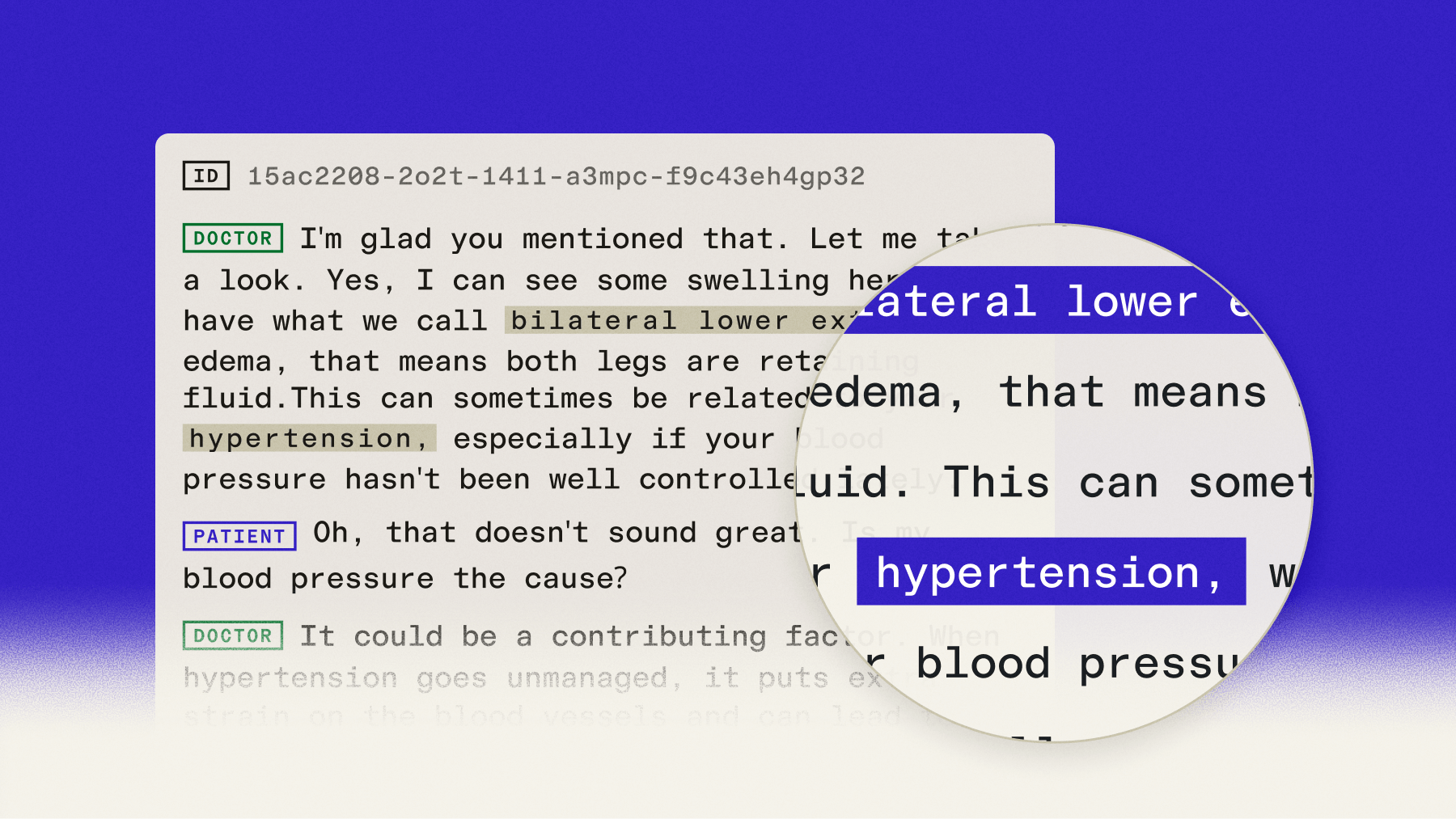

Clinical documentation is still the biggest tax on a clinician's day. Physicians spend hours after the last patient leaves cleaning up notes, and every one of those hours is a data-entry problem dressed up as care. Medical speech recognition software exists to give that time back—turning what a provider says into a structured, accurate note without the keyboard in between.
But here's the part most buying guides skip: the term "medical speech recognition software" now covers two very different things. On one side you have finished ambient-scribe apps that record a visit and hand back a SOAP note. On the other you have speech-to-text APIs that give you the raw accuracy and the building blocks to design your own workflow. Which one is right depends entirely on whether you're a clinic buying a tool or a team building a product. I'll cover both, and I'll be direct about where each of the 8 solutions below actually fits.
What is medical speech recognition software?
Medical speech recognition software converts spoken clinical language into written text using automatic speech recognition (ASR) that's been tuned for healthcare. General models trip over the vocabulary that matters most—drug names, dosages, anatomical terms, and clinical abbreviations. A consumer model might transcribe "metformin" as "met for men." In a medical note, that's not a typo, it's a safety issue.
Under the hood, these systems pair an acoustic model that processes the audio with a language model that understands medical context, so "Humira" and "Humalog" don't get swapped. In practice, they show up in three shapes:
- Front-end dictation: real-time transcription where the clinician watches text appear as they speak.
- Back-end transcription: batch processing of recorded audio for later review.
- Ambient scribing: AI that listens to the full provider-patient conversation and drafts a structured note automatically.
Adoption is climbing fast. Roughly 68% of physicians now report using AI for documentation tasks, and 57% of healthcare organizations name administrative-burden reduction as their top AI opportunity. The category has moved well past dictation—modern platforms structure notes into SOAP format and pull out clinical entities like diagnoses, medications, and procedures.
What actually matters when you compare medical speech-to-text
Before the vendor list, here's the short version of what separates a demo that impresses from a system you'd trust in production:
- Medical entity accuracy. Word error rate is a blunt instrument for healthcare—getting 98% of the filler words right means nothing if you miss the one drug name that matters. The metric worth watching is missed entity rate: how often the model drops or garbles a clinically meaningful term. That's the number to interrogate. Our full methodology is public on the benchmarks page.
- BAA availability. Non-negotiable. Any vendor touching protected health information should sign a Business Associate Addendum and hold certifications like SOC 2 Type 2.
- Real-time streaming. Front-end dictation and ambient scribing both need low latency. Delay breaks the flow and kills adoption.
- Speaker diarization. Separating provider from patient is what makes a two-person conversation into a usable note.
- Integration model. Direct EHR connectors are simpler but rigid; API-first tools take development effort but let you build exactly the workflow you want.
The 8 best medical speech recognition solutions and APIs
This list spans both camps—developer-facing APIs you build on, and packaged scribe products you deploy. Here's how they stack up on the dimensions that decide a healthcare deployment.
1. AssemblyAI
AssemblyAI is the API I'd reach for if you're building clinical documentation rather than buying a finished scribe. The recommended stack is Universal-3.5 Pro, our flagship async model, with Medical Mode switched on. Medical Mode is domain-optimized for clinical entity recognition, and turning it on is a one-line change—add "domain": "medical-v1" to your request. No model swap, no separate pipeline.
Here's why that matters. Medical Mode reduces the missed entity rate on drugs, conditions, and procedures by roughly 20% compared with Universal-3.5 Pro on its own. Those are exactly the terms that, when dropped, propagate into a SOAP note, a discharge summary, or a downstream LLM and cause real problems. Medical Mode catches them before they leave the transcript.
You can push accuracy further with contextual prompting. In an internal test, feeding the model a prior-visit note as context cut missed medical terms by 31%—the model already knows this patient is on lisinopril, so it's primed to hear it. That kind of steerability is something a locked-down dictation suite simply can't offer.
Medical Mode is a $0.15/hr add-on on top of Universal-3.5 Pro at $0.21/hr, so the combined rate is $0.36/hr, billed by usage rather than per seat. It runs on both pre-recorded and real-time streaming, and it supports English, Spanish, German, and French. Speaker diarization separates provider from patient in recorded consultations, and the RESTful API drops into existing workflows with full documentation.
On compliance: AssemblyAI enables covered entities and their business associates subject to HIPAA to use the AssemblyAI services to process protected health information (PHI). AssemblyAI is considered a business associate under HIPAA, and we offer a standard Business Associate Addendum (BAA) that is required under HIPAA to ensure that AAI appropriately safeguards PHI. If you need to strip PHI before it reaches downstream systems, automatic PII redaction removes identifiers across both audio and transcripts.
Healthcare teams already build on this foundation. DaVita, Sully AI, Heidi Health, Knowtex, Chapter, and NMDP are among the organizations running clinical and healthcare workloads on AssemblyAI—a mix that spans dialysis care, ambient scribes, and Medicare-focused platforms. You can test accuracy on your own clinical audio in the Playground or follow the step-by-step guide to building an ambient AI scribe before you write a line of code.
2. Nuance Dragon Medical One / DAX Copilot
Nuance—now part of Microsoft—remains the incumbent, and for good reason. Dragon Medical One is deeply wired into Epic, Cerner, and other major EHRs, with voice commands for hands-free navigation and specialty vocabularies for radiology, pathology, and more. DAX Copilot (marketed under the Dragon Copilot banner) adds the ambient layer, drafting notes from the full visit conversation. It's the safe institutional choice for large health systems that want a supported, integrated suite. The tradeoff is per-user licensing and a walled-garden model—you get what Nuance ships, not a set of primitives to build on.
3. Amazon Transcribe Medical
AWS offers medical transcription through Amazon Transcribe Medical with pay-as-you-go pricing and both batch and streaming modes. It ships specialty models for primary care, cardiology, neurology, oncology, radiology, and urology, plus medical entity extraction and custom vocabularies. If your stack already lives in AWS, the deployment path is short. It's a solid, no-frills transcription layer, though you'll be assembling the note-generation logic yourself.
4. Deepgram Nova-3 Medical
Deepgram's Nova-3 Medical is a healthcare-tuned version of its Nova-3 model, aimed squarely at developers who want fast, usage-priced streaming transcription with medical vocabulary. It's a direct API competitor to AssemblyAI in this space. If you're weighing the two head-to-head on clinical accuracy and cost, we wrote a dedicated AssemblyAI vs Deepgram for medical transcription comparison, and the full benchmark methodology is on the benchmarks page.
5. Google Cloud
Google's approach is a two-part build: Cloud Speech-to-Text handles transcription while the Healthcare Natural Language API extracts medical entities from the resulting text. It supports FHIR for interoperability and custom vocabularies for practice-specific terms. Powerful if you're already committed to Google Cloud and comfortable stitching services together—but it's infrastructure, not a ready-made application.
6. Microsoft Azure AI Speech
Azure AI Speech brings custom speech models and healthcare vocabulary tuning to Microsoft-centric organizations, with streaming support and the compliance posture large enterprises expect. Combined with Azure's broader health data services, it's a credible option for teams standardized on Microsoft—and it now sits alongside Nuance in the same portfolio, which is worth factoring into long-term platform decisions.
7. DeepScribe
DeepScribe is an ambient AI scribe, not an API. It records natural patient conversations and generates clinical notes without templates or voice commands, pre-charts patient history before visits, and suggests billing codes. It handles the workflow end to end, from capture through EHR submission, with a focus on primary care and specialty clinics. It's a finished product for practices that want to buy documentation, not build it.
8. Suki AI
Suki is a voice-driven clinical assistant that generates ambient notes and responds to voice commands, integrating with common EHRs. Like DeepScribe, it's aimed at clinicians who want a packaged assistant rather than a set of developer tools. It's a strong pick if your goal is a turnkey experience for providers and you don't need to customize the underlying pipeline.
Benefits of medical speech recognition software
The core payoff is time. Voice documentation lets physicians complete notes far faster than typing, which directly attacks the after-hours "pajama time" that fuels burnout. But the benefits compound past the clock:
- Fewer dangerous errors. Models trained on clinical speech catch drug names and dosages that general transcription mangles.
- Better provider experience. Less time on documentation means more time for patients—or for a life outside the clinic.
- Stronger patient connection. When clinicians aren't buried in a keyboard, patients report feeling more heard.
- Cleaner revenue. More complete documentation supports accurate coding and fewer claim denials.
Common use cases
Medical speech recognition shows up across nearly every clinical setting. The obvious one is core clinical documentation—SOAP notes, progress notes, and discharge summaries dictated between rounds. Beyond that:
- Specialty reporting in radiology, pathology, and surgery, where precise terminology and measurements are everything.
- Telemedicine visits, where audio quality varies wildly and the model has to hold up against background noise and consumer microphones.
- Ambient clinical intelligence that passively captures the exam-room conversation and drafts the note, separating clinical detail from small talk.
- Medical coding and prior authorization, where transcribed encounters feed CPT and ICD-10 extraction. These downstream workflows are a natural fit for the LLM Gateway, which runs your transcripts through the model of your choice to generate structured notes and suggest codes.
Challenges to plan for
None of this is magic, and pretending otherwise on a healthcare buying decision would be irresponsible. The recurring hurdles:
- Accent and dialect variability that trips models trained narrowly on one speaking population.
- Hospital noise—monitor alarms, overhead pages, hallway traffic—that degrades even good models.
- Medical homophones like "Humira" vs "Humalog," "ileum" vs "ilium," and "radical" vs "radial." These aren't cosmetic errors; they're patient-safety issues that demand quality control and, ideally, a model whose missed entity rate you've actually measured.
- Integration complexity with legacy EHRs that lack modern APIs, and the configuration work of mapping transcribed text to structured fields.
- Change management, because the best tool fails if clinicians won't adopt it.
How to choose in 2026
Here's the insight that took the industry a few years to internalize: the winning number in clinical speech isn't overall word error rate—it's whether the model preserves the medical entities and whether you can steer it toward the terms a specific patient's chart implies. A system that nails 99% of ordinary words but drops one medication name is worse than useless in a note; it's a liability. That reframing is why missed entity rate, contextual prompting, and PHI handling now matter more than the headline accuracy figure most vendors lead with.
It also explains why the market is quietly splitting in two. If you're a clinic that wants documentation handled, buy a packaged scribe—Dragon, DAX, DeepScribe, or Suki will get you there. If you're a team building a product, or you want to own the workflow, accuracy, and cost curve, build on an API. That's the camp AssemblyAI is built for: usage-based pricing instead of per-seat licenses, one parameter to enable Medical Mode, contextual prompting to squeeze out the last errors, and a BAA when you're processing PHI. The teams shipping the most interesting clinical documentation in 2026 aren't buying a finished box—they're building on the primitives.
Frequently asked questions
What's the difference between medical dictation and regular speech-to-text?
Medical dictation runs on models trained specifically on healthcare terminology, drug names, and clinical language patterns. Regular speech-to-text frequently misreads medical terms, which can create dangerous errors in a note. The practical gap shows up in missed entity rate—how often clinically meaningful terms get dropped or garbled.
How does AssemblyAI's Medical Mode improve accuracy?
Medical Mode is domain-optimized for clinical entity recognition and reduces the missed entity rate on drugs, conditions, and procedures by roughly 20% compared with Universal-3.5 Pro alone. You enable it with a single parameter, "domain": "medical-v1", on both pre-recorded and real-time streaming, in English, Spanish, German, and French. You can push accuracy further with contextual prompting—in an internal test, supplying a prior-visit note cut missed medical terms by 31%.
How does AssemblyAI handle HIPAA and patient data?
AssemblyAI is considered a business associate under HIPAA and offers a standard Business Associate Addendum (BAA) for customers processing PHI. Specifically, AssemblyAI enables covered entities and their business associates subject to HIPAA to use the AssemblyAI services to process protected health information, and the BAA is required under HIPAA to ensure PHI is appropriately safeguarded. AssemblyAI also maintains SOC 2 Type 2. You can request a BAA through our security page.
Can medical speech recognition software redact PHI and PII?
Yes. AssemblyAI offers automatic PII redaction that detects and removes personally identifiable and protected health information across both audio and transcripts, helping teams limit the PHI that flows into downstream notes and analytics.
Does it integrate with existing EHR systems?
Most solutions integrate with major EHRs through direct connectors or APIs. Packaged scribes like Dragon and DeepScribe favor direct integrations, while API-first platforms like AssemblyAI, Amazon, Deepgram, Google, and Azure give you the flexibility to map transcripts into whatever EHR workflow you're building. Complexity depends on your EHR and how custom the workflow needs to be.
Can it handle multiple speakers in a clinical conversation?
Yes. Speaker diarization separates provider dictation from patient responses and background conversation, which is what makes a recorded, multi-person visit into a usable, attributable note.
Compare pricing and build your first medical transcription request →
Lorem ipsum dolor sit amet, consectetur adipiscing elit, sed do eiusmod tempor incididunt ut labore et dolore magna aliqua. Ut enim ad minim veniam, quis nostrud exercitation ullamco laboris nisi ut aliquip ex ea commodo consequat. Duis aute irure dolor in reprehenderit in voluptate velit esse cillum dolore eu fugiat nulla pariatur.
Related posts
.png)