Text Summarization for NLP: 5 Best APIs, AI Models, and AI Summarizers in 2026
In this article, we’ll discuss what exactly text summarization is, how it works, and a few of the best Text Summarization APIs, AI models, and AI summarizers.


As of 2026, text summarization for NLP is the automated process of condensing documents, transcripts, or audio and video into their key points using extractive or abstractive AI models. This guide covers how it works, how to evaluate it, and the best text summarization APIs and AI summarizers to build with today.
Text summarization has become essential for processing the overwhelming amount of text data generated daily. As industry data indicates, the use of virtual meetings alone increased from 48% to 77% between 2000 and 2022. From research papers and legal documents to customer conversations and meeting transcripts, Natural Language Processing (NLP) makes it possible to automatically condense lengthy texts into their most important points, turning hours of reading into minutes of insight.
In NLP, text summarization models automatically shorten documents, papers, podcasts, videos, and more into their most important soundbites. Product teams integrate these AI models into their platforms to automatically summarize calls, interviews, legal documents, and more — the tools you sometimes see called AI summarizers.
This article gives you a complete overview of text summarization for NLP: the fundamental concepts, the different approaches and evaluation methods, practical implementation through APIs, and real-world applications. Whether you’re a developer building summarization or a technical leader evaluating solutions, you’ll learn how to choose and apply the right approach for your needs.
What is text summarization for NLP?
Text summarization for NLP automatically converts long documents, conversations, and media into concise summaries using AI models. These systems pull key information from any text source — research papers, meeting transcripts, or audio and video content — and deliver actionable insights in seconds when combined with a speech-to-text API.
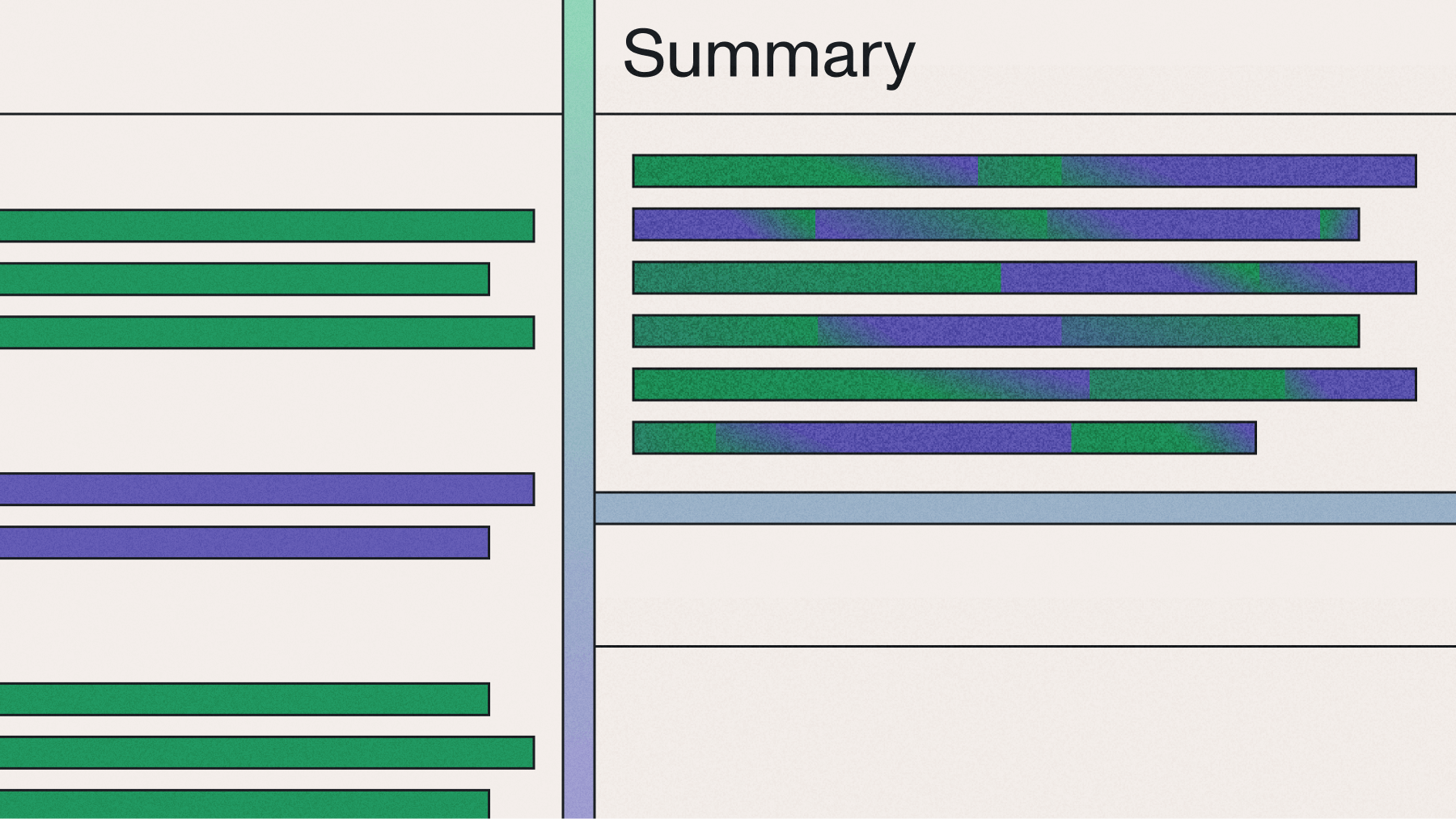
Some text summarization APIs return a single summary for a text, regardless of length. Others break the summary into shorter, time-stamped segments.
Say you wanted to summarize the 2021 State of the Union Address — an hour-and-43-minute video. Using a summarization feature with time stamps, you might generate summaries for key sections like these:
- 1:45 — I have the high privilege and distinct honor to present to you the President of the United States.
- 31:42 — 90% of Americans now live within 5 miles of a vaccination site.
- 44:28 — The American Jobs Plan is going to create millions of good-paying jobs.
- 47:59 — No one working 40 hours a week should live below the poverty line.
- 61:58 — I will not impose any tax increase on people making less than $400,000.
- 74:12 — After 20 years of valor and sacrifice, it’s time to bring those troops home.
Other summarization models break long audio, video, or text into more succinct formats — bullets, a paragraph, a headline, or an ultra-brief gist.
Bullets
- Josh Seiden and Brian Donohue discuss outcome versus output on Inside Intercom. Josh is a product consultant and author of a new book, Outcomes Over Output. Brian is a product management director looking forward to the chat.
- The book’s premise is that by defining outcomes precisely, teams can apply the idea of outcomes in their work — in contrast to a broad, undefined use of the word.
- Product teams should focus on the outcome of their work rather than on business impact alone, staying aware of the customer experience.
- Josh’s advice for teams changing how they work: start small, use retrospectives, and improve your process as you go.
Paragraph
Josh Seiden and Brian Donohue discuss outcome versus output on Inside Intercom. Josh Seiden is a product consultant and author who has just released a book called Outcomes Over Output. Brian is a product management director, and he’s looking forward to the chat.
Headline
Josh Seiden and Brian Donohue discuss outcomes versus output on Inside Intercom.
Gist
Outcomes over output
Types of text summarization
Text summarization systems fall into distinct categories based on three factors:
- Approach — extractive methods pull existing sentences; abstractive methods generate new text.
- Input source — a single document versus synthesis across multiple documents.
- Output format — headlines, paragraphs, bullet points, or ultra-brief gists.
Extractive vs. abstractive approaches
Categorization by input source
Summarization systems also differ based on what they’re designed to process:
- Single-document summarization condenses one text at a time — ideal for individual articles, transcripts, or reports.
- Multi-document summarization synthesizes information from several related texts into one unified summary. This works well for overviews built from multiple news articles or research papers on the same topic.
Categorization by output format
Different use cases need different formats, and modern systems can generate several types:
How does text summarization work?
There’s no single answer — a wide range of methods have been developed over decades. In fact, academic research shows the study of automatic text summarization began as early as 1958. These methods generally fall into two categories: extractive and abstractive.
Extractive methods extract the most pertinent information from a text. Abstractive methods generate novel text that summarizes the original. Abstractive methods produce more flexible and often more faithful summaries, especially in the age of large language models — but that flexibility comes with risk. Some research suggests nearly 30% of summaries from abstractive systems may contain factual errors.
Extractive text summarization methods
Extractive methods work by identifying and extracting the salient information in a text. The variety of extractive methods amounts to different ways of deciding what information matters.
Frequency-based methods rank sentences by how often important words appear. Each word carries a weight — usually a function of the word’s importance and how frequently it appears across the document — and those weights determine which sentences to return.
Graph-based methods cast documents as mathematical graphs, where each sentence is a node and nodes connect when sentences are similar. What counts as “similar” varies by algorithm — one implementation might threshold the cosine similarity between TF-IDF vectors. Sentences with the highest centrality carry the most summarizing information and get extracted. A well-known example is TextRank, an adaptation of Google’s PageRank algorithm for summarization.
Abstractive text summarization methods
Abstractive methods generate a novel summary of the information in a text. While there are linguistic approaches, AI models — casting summarization as a seq2seq problem — have proven extremely powerful over the past several years, with research dating back to 2015 first applying deep learning to the task. The invention of the Transformer had a profound impact here, as it did across NLP.
More recently, large language models have been applied to summarization. LLMs aren’t trained directly to summarize, but they become competent general generative AI models as they scale — and summarization comes along with it.
LLM-based, summarization-specific approaches have also been explored, using pre-trained models refined with Reinforcement Learning from Human Feedback (RLHF), the core technique that evolved GPT into ChatGPT. Human feedback trains a reward model, which updates an RL policy — producing a more easily prompted model that tailors output to human expectations for a “good” summary. Text summarization remains an active research field; recent research shows that Reinforcement Learning from AI Feedback (RLAIF) can match RLHF on tasks that include summarization.
Key terminology
- Extractive summarization — identifies and extracts the most important sentences from source text.
- Abstractive summarization — generates novel sentences that capture the essence of the source material.
- ROUGE metrics — measure word overlap between generated and reference summaries.
- LLM Gateway — AssemblyAI’s single API for calling leading LLMs (OpenAI, Anthropic, Google, and more) on transcript data.
How accurate is AI text summarization?
As of 2026, AI text summarization is accurate enough for production in most workflows, but accuracy depends on two things: the summarization method and the quality of the input text. Extractive methods stay faithful to the source because they reuse existing sentences. Abstractive methods read more naturally but can hallucinate — research shows nearly 30% of AI-generated summaries may not match source facts.
For audio and video, accuracy is bounded by the transcript underneath it. If a speech-to-text model mishears “quarterly revenue” as “courtly revenue,” the summary inherits the error. That’s why summary quality starts with an accurate transcript — a point we return to below.
Text summarization evaluation methods
Summary quality is judged with both automated metrics and human review.
- ROUGE (Recall-Oriented Understudy for Gisting Evaluation) — measures word overlap between generated and reference summaries.
- BLEU (Bilingual Evaluation Understudy) — compares n-gram matches with human-written references.
- Human evaluation — the ultimate test for coherence and accuracy.
Automated metrics enable benchmarking but don’t capture semantic meaning perfectly. Supporting this, a recent scoping review of LLM studies found that over half used a hybrid approach — making the most reliable evaluation one that combines automated scores with human review.
Real-world applications and use cases
Text summarization powers workflows across industries, turning voice and text data into actionable insights. Common benefits include scalable analysis (processing 100% of conversations instead of random samples), real-time insights, and shared intelligence across departments.
Media and content creation
Video editing platforms and podcasting tools use summarization to automatically generate chapters, show notes, and descriptions. Timestamped summaries let viewers jump to relevant sections, improving engagement and watch time while saving creators hours of manual work.
Meeting and call analysis
Companies use summarization for concise meeting recaps and call summaries, capturing key decisions, action items, and discussion points without manual note-taking. AI notetakers like Fireflies and Notta build on this so teams no longer miss critical information from meetings they couldn’t attend. See our AI notetakers use case for more.
Conversation intelligence
Revenue and contact center platforms summarize sales and support calls to surface key moments and track performance. Supervisors can review dozens of calls by reading summaries instead of listening to hours of recordings, with the technology flagging competitor mentions, pricing discussions, or customer objections for deeper review. For the full picture, see our guide to conversation intelligence.
Document processing
Legal, research, and financial teams use summarization to speed up document review — a use case validated by specialized research datasets like BillSum, which contains more than 23,000 U.S. Congressional bills and their summaries. Analysts can grasp the key points of contracts, papers, or regulatory filings without reading hundreds of pages.
Healthcare documentation
Medical practices use summarization to turn lengthy patient encounters into concise clinical notes. For instance, one case study involving a behavioral health AI scribe saw a 90% reduction in documentation time for clinicians. Summarization also supports patient handoffs, communicating critical information clearly between care teams.
Text summarization techniques
Choosing a technique comes down to your requirements. When evaluating vendors, research on AI integration shows product teams prioritize cost (64%), quality and performance (58%), and accuracy (47%) above other factors.
- Extractive summarization works best for high factual-accuracy needs (legal, compliance), quick identification of key passages, and cases requiring traceability to the source.
- Abstractive summarization excels when you need natural, readable summaries, when you’re processing conversational content like meetings and calls, and when you’re generating novel formats like headlines or social posts.
For many product teams, the flexibility of abstractive methods is worth the added complexity, especially with modern AI models.
Best APIs for text summarization
Now that we’ve covered what text summarization is and how it works, here’s a comparison of the best text summarization APIs and AI summarizers to build with as of 2026. Some support summarization on pre-existing text like a research paper; others summarize on top of audio or video transcriptions from a podcast or virtual meeting.
1. AssemblyAI’s summarization models
AssemblyAI is a Voice AI infrastructure platform building models that understand and process human speech. Its AI models for summarization deliver leading accuracy on audio and video, returning summaries as bullets, gist, paragraph, or headline (see the examples above).
For maximum flexibility, LLM Gateway — AssemblyAI’s single API to leading LLMs from OpenAI, Anthropic, Google, and others — is the recommended way to generate summaries in any custom format by prompting a model with your transcript data. As of 2026, LLM Gateway is the current recommended path for custom summaries and chapter generation. The older Auto Chapters and Summarization add-ons remain available on Universal-2 for existing workflows, but LLM Gateway is where new development should start. You can read more in the LLM Gateway raunch announcement.
Summarization sits on top of accurate transcription — and that foundation matters. AssemblyAI’s flagship async model, Universal-3.5 Pro (universal-3-5-pro), released July 2026, is trained on millions of hours of audio and adds native code-switching across 18 languages and the company’s most accurate speaker diarization yet. More accurate transcripts make every summary generated from them more reliable. You can see the numbers on the benchmarks page.
Teams building AI notetakers, meeting platforms, and conversation intelligence products build on this stack. As Granola put it:
“The speed difference is immediately noticeable — our users see their conversations transcribed almost instantaneously. It feels so much more responsive than what we were using before.”
Beyond raw transcription, Speech Understanding models — sentiment analysis, entity detection, topic detection, and key phrases — round out the analysis layer, and pricing for every model and add-on is on the pricing page.
2. Microsoft Azure text summarization
As part of its Azure AI Language service, Azure’s Text Summarization API offers extractive summarization for articles, papers, or documents. Getting started requires an Azure subscription and the Visual Studio IDE. Pricing is pay-as-you-go, though prices vary with usage and features.
3. NLP Cloud summarization API
NLP Cloud offers several NLP APIs, including text summarization, plus support for fine-tuning and deploying community AI models. Developers can also build, train, and deploy their own custom models. Pricing ranges from $0–$499/month depending on usage.
AI text summarizers: what to look for
An AI text summarizer is the end-user product built on a summarization model or API. When choosing or building one, look for:
- Format flexibility — can it return bullets, paragraphs, headlines, and custom formats? LLM Gateway makes custom formats straightforward.
- Input coverage — does it handle text only, or audio and video too? Audio and video require accurate speech-to-text first.
- Accuracy and faithfulness — how well does it avoid hallucination, and how good is the transcript underneath?
- Scale and latency — can it process one document or thousands, and does it meet your real-time or batch needs?
Implementation considerations for production systems
Production deployment requires planning around input quality, user experience, and scale. Address these constraints upfront to avoid costly redesigns later.
Input quality and preprocessing
Summary quality is directly tied to input quality. As industry research confirms, “If the words are wrong, the outcomes are too.” For audio and video, that means starting with a highly accurate transcript — transcription errors cascade through the summarization pipeline. If you’re evaluating models, our guide on how to evaluate speech recognition models is a good place to start.
Consider preprocessing for your content type: documents may need formatting cleanup, while conversation transcripts often need speaker diarization to keep context. Some content benefits from noise reduction or normalization first.
Latency and user experience design
Applications have different speed requirements. Real-time assistants need summaries within seconds; batch processing for document archives can run overnight. Your choice shapes both architecture and UI — decide whether you need real-time partial summaries as content streams in, or whether users can wait for complete processing, and plan progress indicators accordingly.
Scale and infrastructure planning
Production systems must handle variable loads gracefully — scaling from a few documents to thousands without failing. Plan for peak-load handling, queue management for batch jobs, fallback strategies when services are unavailable, and cost optimization across usage tiers. Scalable API infrastructure lets you focus on application logic instead of model deployment.
Output customization and formatting
Applications often need summaries in specific formats — a support platform might need timestamped bullets, while a research tool needs paragraph summaries with citations. Plan how you’ll customize summary length by content type, keep formatting consistent across inputs, handle edge cases like very short or very long content, and integrate summaries into existing workflows and UIs.
Getting started with text summarization
Text summarization transforms how we process information from documents, audio, and video, surfacing insights that would otherwise stay buried in raw data. Getting started doesn’t require deep NLP expertise — production-ready APIs handle the complexity so you can focus on your application. Try our API for free to experiment with summarization on your own files and start building immediately.
Additional resources:
- How to use AI to automatically summarize meeting transcripts
- Summarize audio and video files at scale with AI
- Build standout call coaching features with AI summarization
Frequently asked questions about text summarization
What is the best API for text summarization?
As of 2026, the best API depends on your input. For audio and video, an API-first Voice AI platform like AssemblyAI is strongest because it pairs accurate transcription with flexible summary formats and custom summaries through LLM Gateway. For document-only workflows in the Microsoft ecosystem, Azure’s extractive summarization is a reasonable fit.
How does extractive text summarization differ from abstractive summarization in practice?
Extractive summarization selects and combines existing sentences from the source, like highlighting key passages. Abstractive summarization generates entirely new text that paraphrases the main ideas in different words.
What is the difference between a text summarizer and an NLP summarization model?
An NLP summarization model is the underlying AI that condenses text. A text summarizer (or AI summarizer) is the end-user product built on top of that model or an API — the app people actually interact with.
Can you summarize audio and video, not just text?
Yes. First, a speech-to-text model transcribes the audio into a written transcript. Then a summarization model — or a custom prompt through LLM Gateway — condenses that transcript into your chosen format.
What are common misconceptions about text summarization accuracy?
A common misconception is that summaries are always factually perfect. Abstractive summaries can generate plausible but incorrect information (hallucination), with research showing nearly 30% of AI-generated summaries don’t match source facts.
What prerequisites are needed to implement text summarization effectively?
Clean input text is essential — transcription errors from poor speech-to-text models cascade into unreliable summaries. For audio and video, start with the most accurate transcript you can produce.
Lorem ipsum dolor sit amet, consectetur adipiscing elit, sed do eiusmod tempor incididunt ut labore et dolore magna aliqua. Ut enim ad minim veniam, quis nostrud exercitation ullamco laboris nisi ut aliquip ex ea commodo consequat. Duis aute irure dolor in reprehenderit in voluptate velit esse cillum dolore eu fugiat nulla pariatur.
Related posts