Medical voice recognition: How AI solves terminology problems
See why traditional speech recognition fails with medical terms and how new AI models like Universal-3 Pro deliver leading healthcare terminology accuracy.



Healthcare practitioners are drowning in paperwork, with a recent study revealing physicians spend an average of 1.77 hours daily completing documentation outside office hours. The average doctor spends 16 minutes per patient just dealing with electronic health records — time taken from actual care. And McKinsey analysis finds healthcare burns through $1 trillion annually on administrative tasks, roughly 25 percent of total spending, with much of that waste tracing back to documentation systems that don't work.
Some healthcare systems are turning to automation. But while your smartphone's voice assistant nails everyday conversation, when you drop that technology into a hospital, performance crashes on specialized vocabulary.
It's not the beeping machines or hallway chatter causing the problem, either. It's the specialized language that doctors speak every day. When a cardiologist says "myocardial infarction with ST-elevation," most speech-to-text systems spit out something that looks like autocorrect gone wrong.
Better microphones won't fix this. Quieter rooms won't either. What healthcare needs is Voice AI that actually understands medical language with precision — and that holds true from hospital systems to veterinary practices, anywhere specialized medical vocabulary matters. New advances in speech language models are finally making that possible.
What is medical speech recognition?
Medical speech recognition is specialized Voice AI that accurately transcribes complex medical terminology, pharmaceutical names, and clinical conversations — capturing the drug names, dosages, and diagnoses that general speech-to-text systems frequently get wrong.
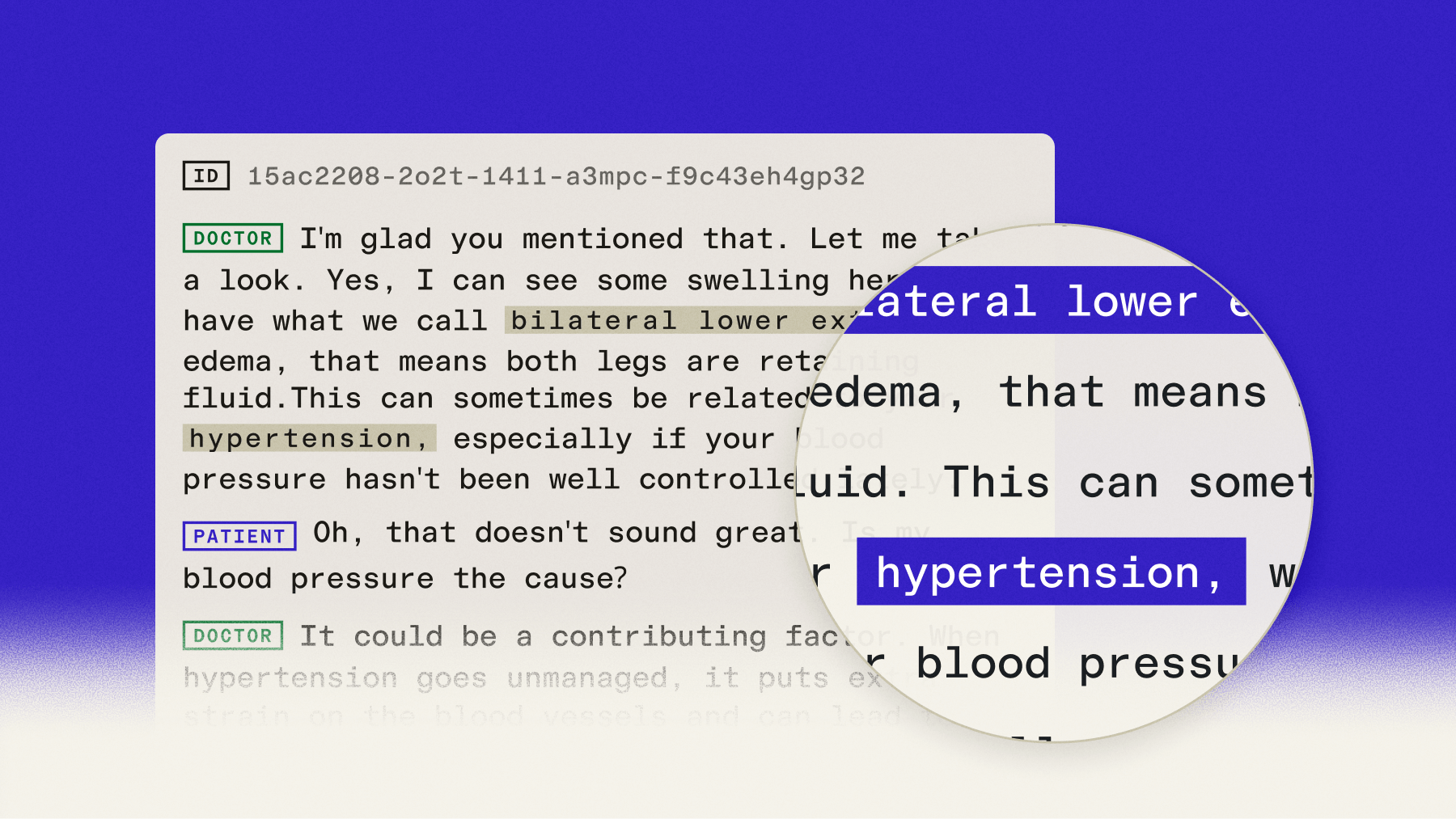
The technology processes acoustic patterns while maintaining semantic understanding of medical concepts. When a physician dictates "patient presents with dyspnea on exertion and orthopnea," the system recognizes these as specific cardiac or pulmonary symptoms, not random sounds.
Modern medical speech recognition integrates several key capabilities:
- Clinical terminology recognition: Accurate transcription of medical terms, drug names, and procedure codes specific to various specialties
- Context-aware processing: Understanding that "MI" means myocardial infarction in cardiology but might mean something different in other contexts
- Multi-speaker environments: Handling overlapping conversations in busy clinical settings with equipment noise and multiple practitioners
- Real-time documentation: Supporting both live dictation during clinical conversations and post-visit narrative recording
The goal isn't just converting speech to text — it's creating accurate, structured clinical documentation that maintains the precision required for patient care, billing compliance, and medical-legal requirements.
Why traditional speech recognition models struggle in healthcare
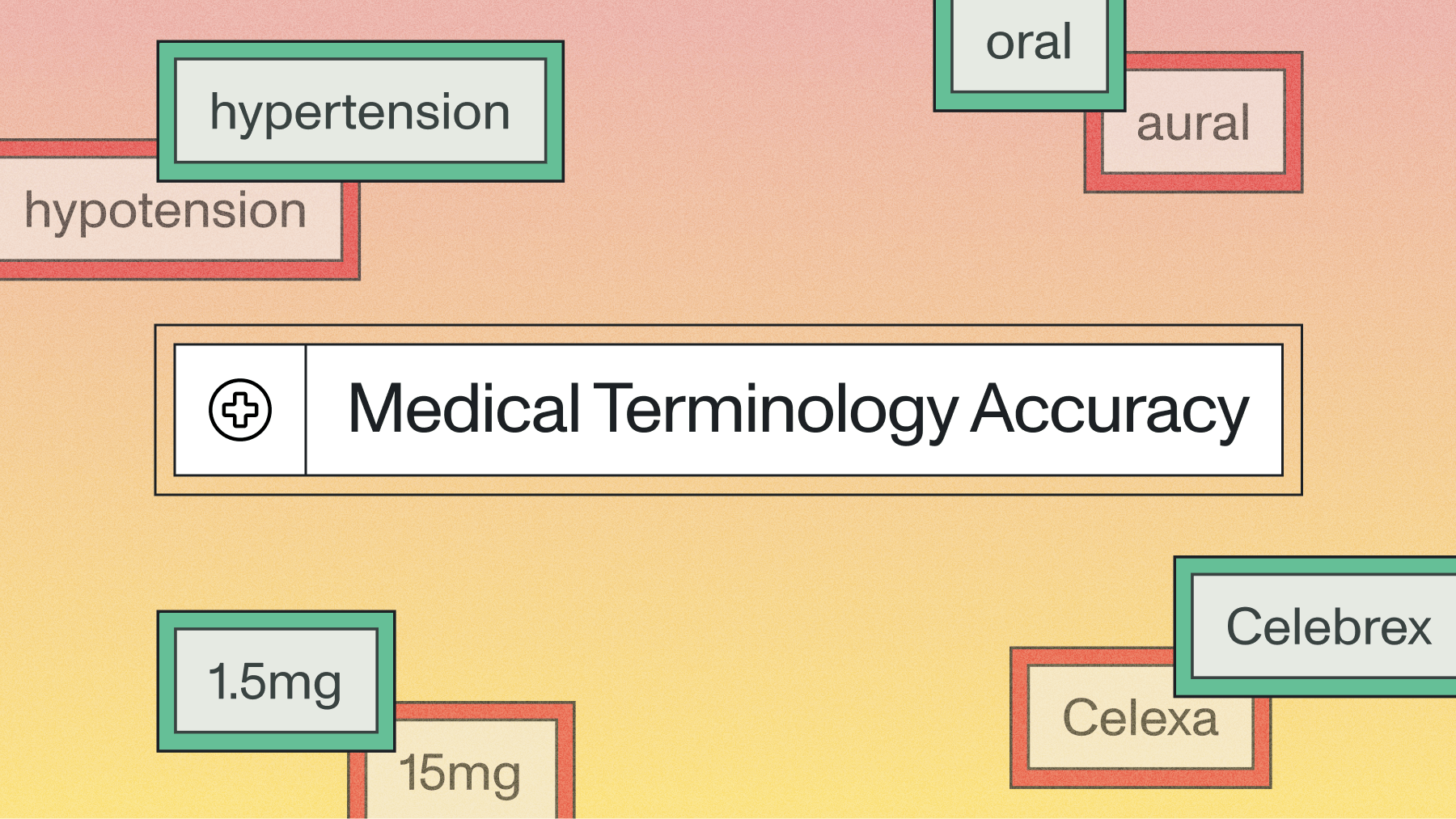
Traditional speech-to-text models fail with medical terminology because they're trained on general datasets where medical terms appear rarely. When an AI voice agent encounters "pneumothorax" once for every million instances of common words like "awesome," the statistical imbalance causes consistent recognition failures.
This statistical rarity creates a cascade of problems. Medical terms don't just sound different — they follow entirely different linguistic rules. Pharmaceutical names blend Latin roots with modern chemistry. Anatomical terms stretch across multiple syllables with precise pronunciation requirements. And medical acronyms are context minefields where "MI" could mean myocardial infarction, mitral insufficiency, or medical interpreter depending on the specialty.
[CTA — Playground] Try Medical Mode free in your browser
General ASR often stumbles on domain-specific terms. Upload clinical audio and instantly see how Universal-3 Pro with Medical Mode recognizes drug names, acronyms, and multi-syllable medical phrases — no code required.
Button: Try the playground → https://www.assemblyai.com/playground
Clinical environments create acoustic challenges that break standard automatic speech recognition:
- Emergency departments: Urgent conversations over equipment alarms
- Operating rooms: Multiple speakers wearing masks
- ICU consultations: Discussions over ventilator noise
Research confirms this vulnerability, showing a 7.4% error rate in notes generated by speech recognition software before human review.
The industry has tried patches:
- Custom vocabulary training demands specialty-specific datasets and constant updates as medical knowledge evolves.
- Post-processing correction systems layer rule-based fixes on top of broken transcriptions, often creating new errors.
- Specialized medical models cost six figures, lock you into narrow use cases, and have generalization and contextual-understanding issues.
- Legacy word boosting often fails with long lists of terms, as most words become distractors. Modern approaches like Universal-3 Pro's keyterms_prompt and contextual prompt parameters are far more effective, using the provided terms to understand domain context rather than just boosting individual words.
These aren't solutions. They're expensive workarounds for fundamentally mismatched technology.
Universal-3 Pro and Medical Mode: a new approach to medical speech recognition
AssemblyAI's Universal-3 Pro model introduces a new approach to medical speech recognition. Instead of simply training on more medical data, it builds on a fundamentally different architecture: a Speech-augmented Large Language Model (SpeechLLM) that combines powerful LLM reasoning with specialized audio processing.
This isn't just better pattern matching. It's genuine understanding. Most speech recognition systems hear audio patterns and map them to text sequences. Universal-3 Pro hears the audio, processes the semantic meaning, then generates appropriate text based on context. When it encounters "bilateral pneumothorax," it doesn't just recognize the sound pattern — it understands that this refers to collapsed lungs on both sides and maintains that precision throughout the transcript.
On top of Universal-3 Pro sits Medical Mode: a domain-optimized configuration for medical entity recognition, built on Universal-3 Pro and Universal-3 Pro Streaming. It catches terminology errors before they propagate into SOAP notes, discharge summaries, or downstream LLMs. You activate it with one parameter — domain="medical-v1" — on either Universal-3 Pro (async) or Universal-3 Pro Streaming.
The benchmarks back it up. On AssemblyAI's medical evaluation, Universal-3 Pro with Medical Mode posts a 3.2% Missed Entity Rate (MER) — roughly 20% fewer missed medical entities than Universal-3 Pro alone, and the lowest MER across benchmarked providers including Deepgram, Speechmatics Enhanced Medical, AWS Transcribe Medical, and Google. You can see the full results on the benchmarks page. Medical Mode is available in English, Spanish, German, and French, for both pre-recorded and streaming, and it's a $0.15/hr add-on — $0.36/hr total with Universal-3 Pro.
Universal-3 Pro integrates with critical healthcare features like speaker diarization and timestamp prediction. Developers can use the keyterms_prompt parameter to provide up to 1,000 domain-specific terms (pharmaceutical names, procedure codes, anatomical references) for improved recognition. For even greater control, the prompt parameter allows up to 1,500 words of natural language to guide the model on context, formatting, and style.
Customer applications across healthcare
Healthcare technology companies are building real products on medical Voice AI:
These organizations follow a predictable pattern: pilot programs in specific departments, measured improvements in documentation efficiency, then organization-wide expansion. Mental health and wellness platforms such as Perci Health and therapz.com use AssemblyAI's technology to support therapy session documentation and patient engagement. As one case study shows, behavioral health AI scribe JotPsych enabled a 90% reduction in documentation time for clinicians. Accurate transcription of sensitive clinical conversations enables better care continuity and treatment planning.
The measurable benefits these organizations report include:
- Documentation efficiency gains: Substantial reduction in administrative time — in one notable example, The Permanente Medical Group saved nearly 16,000 hours in a single year.
- Improved accuracy: Fewer transcription errors requiring correction, leading to better billing accuracy
- Enhanced engagement: Practitioners can focus on patients rather than screens during consultations
- Scalability: Ability to handle increasing volumes without proportional increases in documentation burden
Industry-specific applications and use cases
AI medical scribes and clinical documentation
Companies like PatientNotes.app and Clinical Notes AI report significant reductions in documentation time through ambient transcription. These platforms capture natural clinical conversations and generate structured notes automatically, letting practitioners maintain eye contact with patients.
EHR integration and clinical workflows
Healthcare platforms such as T-Pro and MEDrecord integrate Voice AI directly into existing EHR systems, enabling practitioners to dictate notes, orders, and summaries with strong accuracy for medical terminology. Organizations typically see faster chart completion within the first quarter of deployment.
Telehealth and virtual care platforms
Telehealth providers use Voice AI to automatically document virtual consultations while supporting medical record requirements. This improves care continuity and reduces post-visit documentation burden for remote teams.
Specialty-specific implementations
Different specialties leverage Voice AI for their unique challenges. Radiology departments use voice recognition for rapid report generation, emergency medicine relies on real-time transcription for fast-paced encounters, mental health professionals capture sessions while maintaining engagement, and surgical teams use it for operative note dictation.
ROI and business impact of medical Voice AI
Medical Voice AI delivers value across several areas, though specific results depend heavily on workflow and use case:
- Documentation efficiency: Practitioners recover meaningful time per encounter that would otherwise go to manual note-taking
- Operational savings: Fewer transcription errors mean less time on corrections and clarification requests, plus improved billing accuracy
- Capacity: Reduced documentation overhead can free practitioners to see patients without proportional staffing increases
Implementation typically follows a predictable timeline:
- Months 1-2: API integration and pilot program with select practitioners
- Months 3-4: Department-wide rollout with workflow optimization
- Months 5-6: Organization-wide deployment and performance measurement
Beyond direct time savings, medical Voice AI enables workflow models that weren't previously feasible. Ambient clinical documentation lets practitioners maintain eye contact during consultations. Real-time documentation reduces end-of-day charting — which a 2024 AMA survey found consumes over eight hours a week for 22.5% of physicians, a key contributor to burnout.
Choosing the right medical speech recognition solution
Selecting the right technology requires evaluating solutions on criteria that directly impact clinical workflows and patient safety.
Critical evaluation criteria
Medical terminology accuracy: Test the system with actual clinical audio from your specialties. Look for models that correctly identify complex terms, drug names, and procedures without extensive customization. Universal-3 Pro with Medical Mode handles this out of the box, activated with one domain="medical-v1" parameter.
Integration flexibility: Evaluate how easily the solution integrates with your existing EHR and clinical systems. A flexible API that scales across departments and use cases without separate models reduces implementation complexity.
Security and PHI handling: The provider must support your obligations. AssemblyAI enables covered entities and their business associates subject to HIPAA to use AssemblyAI services to process PHI. AssemblyAI is considered a business associate under HIPAA and offers a Business Associate Addendum (BAA) required under HIPAA. Look for SOC 2 certification and robust data security practices.
Developer experience: Well-documented APIs and strong support are critical for fast implementation. Your team should be able to start building and testing quickly.
Performance benchmarks that matter
- Medical terminology accuracy: Evaluate using Missed Entity Rate (MER) on your own clinical audio. On AssemblyAI's benchmarks, Medical Mode posts a 3.2% MER — the lowest of any benchmarked provider.
- Contextual accuracy: Systems should maintain strong accuracy across noisy clinical environments with multiple speakers
- Processing speed: Under-300ms latency for real-time streaming via Universal-3 Pro Streaming
- Scalability: Platform should handle large annual volumes without performance degradation
Implementation considerations for healthcare developers
- Compliance and data security: Any Voice AI handling patient conversations must meet strict data protection standards. An industry survey shows data privacy and security are among the top three challenges for developers using speech recognition. Look for end-to-end encryption, SOC 2 compliance, and clear data processing agreements. AssemblyAI is considered a business associate under HIPAA and offers a Business Associate Addendum (BAA) required under HIPAA.
- EHR integration patterns: Most applications need integration with Epic, Cerner, or other EHRs. Plan your API architecture early so structured output maps cleanly to your documentation formats.
- Latency requirements: Real-time clinical documentation demands different performance than batch. Emergency departments need sub-second response; radiology can tolerate longer processing for higher accuracy.
- Multi-specialty scalability: Your solution should handle cardiology as well as pediatrics without separate models or retraining. Medical Mode covers this with a single domain parameter.
Get started with medical Voice AI
Healthcare voice technology spending is projected to grow rapidly over the next decade, driven by organizations that can't afford current documentation inefficiencies. Universal-3 Pro with Medical Mode delivers a 3.2% MER on medical terminology — the lowest of any benchmarked provider — making medical Voice AI practical for any healthcare organization. One market analysis projects the healthcare voice technology market will grow from $5.6 billion in 2024 to $30.5 billion by 2034.
Frequently asked questions about medical voice recognition
How accurate is Medical Mode, and how does it compare to other providers?
On AssemblyAI's medical benchmarks, Universal-3 Pro with Medical Mode posts a 3.2% Missed Entity Rate — roughly 20% fewer missed medical entities than Universal-3 Pro alone, and the lowest MER of any benchmarked provider. Deepgram Nova-3 Medical lands around 8.7% MER and AWS Transcribe Medical around 24.4% MER. See https://www.assemblyai.com/benchmarks.
How do I turn on Medical Mode, and what does it cost?
Add one parameter — domain="medical-v1" — on Universal-3 Pro (async) or Universal-3 Pro Streaming. It's a $0.15/hr add-on, or $0.36/hr total with Universal-3 Pro, and is available in English, Spanish, German, and French.
Can medical voice recognition be used under HIPAA?
AssemblyAI enables covered entities and their business associates subject to HIPAA to use AssemblyAI services to process PHI. AssemblyAI is considered a business associate under HIPAA and offers a Business Associate Addendum (BAA) required under HIPAA.
What is the typical implementation timeline for medical Voice AI?
API-based solutions can be integrated within days for basic functionality, while full EHR integration and staff training typically takes 6-12 weeks.
How does medical voice recognition integrate with existing EHR systems?
Modern Voice AI integrates through standard APIs and HL7/FHIR protocols, with connectors for Epic, Cerner, and other major EHR platforms.
Which medical specialties benefit most from Voice AI?
Radiology, primary care, and emergency medicine tend to show the highest impact due to high documentation volumes and time-sensitive workflows.
Questions about deployment options across radiology, emergency medicine, or behavioral health? Contact the AssemblyAI team at https://www.assemblyai.com/contact.
Lorem ipsum dolor sit amet, consectetur adipiscing elit, sed do eiusmod tempor incididunt ut labore et dolore magna aliqua. Ut enim ad minim veniam, quis nostrud exercitation ullamco laboris nisi ut aliquip ex ea commodo consequat. Duis aute irure dolor in reprehenderit in voluptate velit esse cillum dolore eu fugiat nulla pariatur.
Related posts