Top text-to-speech APIs in 2026
This guide compares the 12 best TTS APIs in 2026, covering their voice quality, latency, pricing, and ideal use cases to help you choose the right solution for your project.

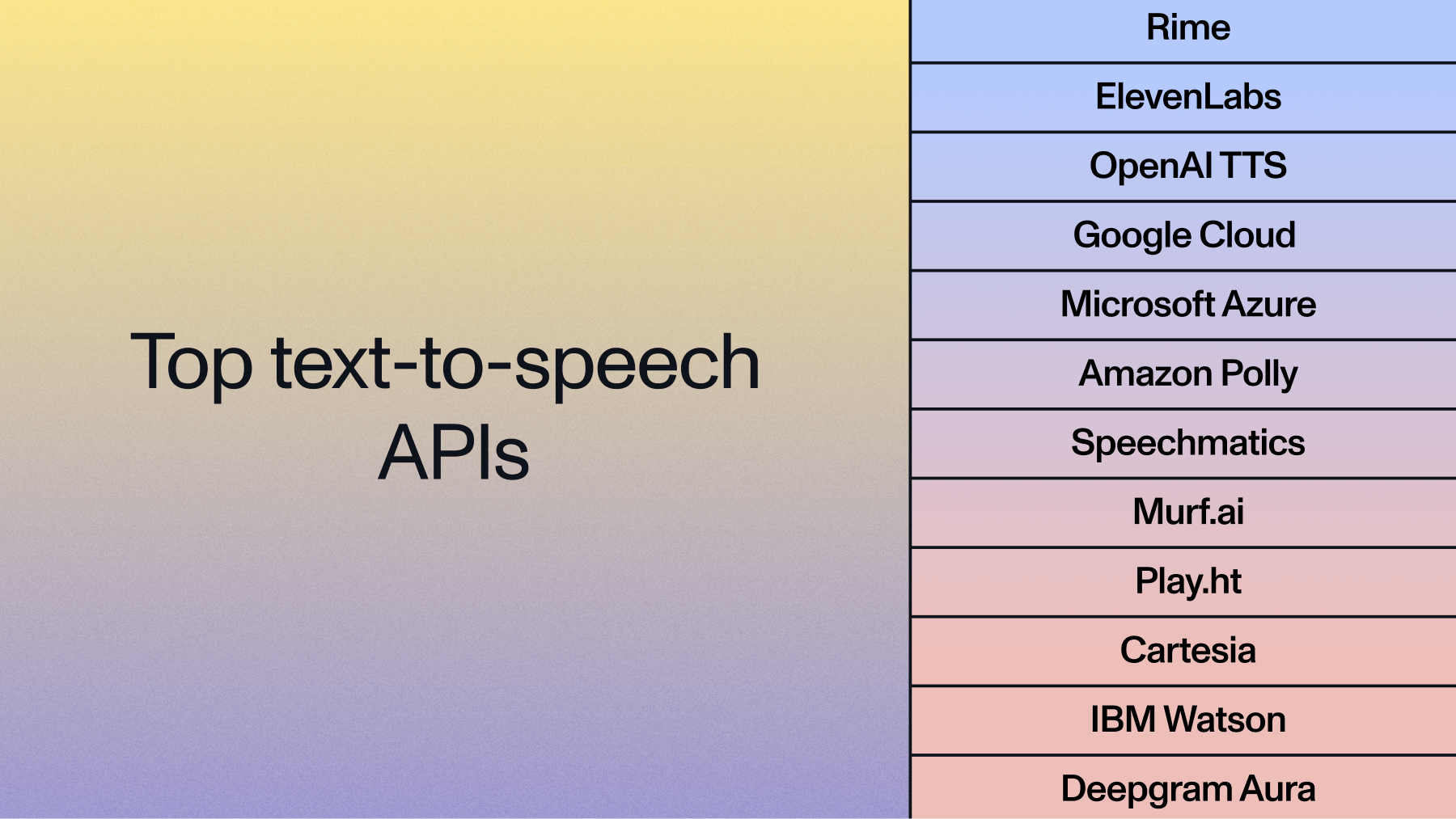

Text-to-speech (TTS) APIs convert written text into natural-sounding audio using neural voice models. With the conversational AI market projected to reach $41.39 billion by 2030, demand for high-quality voice synthesis is accelerating fast.
Whether you're building voice agents, generating podcast narration, or adding speech output to an app, the TTS provider you choose affects latency, voice quality, and cost. This guide compares 12 of the best text-to-speech APIs available in 2026, covering pricing, features, and ideal use cases for each.
Best text-to-speech API comparison
The best text-to-speech APIs in 2026 are Rime, ElevenLabs, OpenAI TTS, Google Cloud TTS, Microsoft Azure TTS, Amazon Polly, Speechmatics, Murf.ai, Play.ht, Cartesia, Deepgram Aura, and MiniMax—evaluated across voice quality, latency, language support, pricing, and developer experience. The table below gives you a quick side-by-side view.
What is a text-to-speech API?
A text-to-speech API is a service that converts written text into spoken audio using AI voice models. Developers send text to an HTTP or WebSocket endpoint and receive synthesized speech in return—typically as streaming audio chunks or a complete audio file.
Under the hood, TTS systems run through several stages:
- Text normalization—expanding abbreviations, numbers, and symbols into speakable words ("$3.50" becomes "three dollars and fifty cents")
- Grapheme-to-phoneme conversion—translating characters into phonetic representations
- Prosody prediction—determining stress, intonation, and rhythm to sound natural
- Neural vocoder—generating the final audio waveform from the predicted features
Most modern APIs also support SSML (Speech Synthesis Markup Language), which lets you control pronunciation, pauses, emphasis, and speaking rate through XML-like tags.
One important distinction: streaming vs. batch. Streaming TTS returns audio in real time as it's generated—critical for voice agents and interactive applications where latency matters. Batch synthesis generates the entire audio file before returning it, which works fine for podcasts, audiobooks, and other pre-recorded content where you don't need instant playback.
Key TTS terms
- TTFB (time-to-first-byte)—the delay between sending text and receiving the first audio frame, the most important latency metric for real-time use cases
- Neural vocoder—the deep learning model that generates the final audio waveform, replacing older concatenative and parametric methods
- Voice cloning—creating a synthetic replica of a specific voice from a short audio sample, used for brand consistency and personalization
- SSML—Speech Synthesis Markup Language, an XML-based standard for controlling pronunciation, pauses, emphasis, and speaking rate
- Prosody—the rhythm, stress, and intonation patterns that make speech sound natural rather than robotic
How to choose a text-to-speech API
The right TTS provider depends entirely on what you're building. Here are the criteria that matter most:
Voice quality. How natural does it sound? The gap between providers is significant—some models still have audible artifacts, while others are nearly indistinguishable from human speech.
This matters more than you might think: 47% of people are concerned about AI handling customer service calls, and according to AssemblyAI's Voice Agent Report, 37.5% of end users cite "robotic or unnatural voice" as a top frustration with current voice agents. Voice quality directly affects user trust.
Always test with your actual content, not cherry-picked demos.
Latency. For voice agents and real-time applications, you need sub-300ms time-to-first-byte—for pre-recorded content, it barely matters. This single factor eliminates many providers from the voice agent use case.
Language support. If you're building for a global audience, check which languages each provider supports with neural voices—not merely listed as "available." The quality difference between a provider's primary and secondary languages can be dramatic.
Pricing model. TTS pricing varies widely—per-character, per-minute, per-hour, and subscription-based—so calculate your expected volume and compare. A provider that's cheapest at 100K characters per month might be expensive at 10M.
Customization. Do you need voice cloning, custom pronunciations, or emotional control? Not every provider supports these, and the ones that do charge differently for them.
Compliance and security. Healthcare, finance, and government applications often require SOC 2, HIPAA eligibility, or data residency options. Filter for these early—retrofitting compliance later is painful.
Ecosystem fit. If your stack is already on AWS or deep in OpenAI, the native TTS option keeps things simple. Don't underestimate the cost of managing another vendor.
Use-case recommendations
- Voice agents—prioritize sub-300ms latency and streaming support. Look at Rime, Cartesia, Deepgram Aura, or ElevenLabs.
- Audiobooks and podcasts—voice consistency and expressiveness matter more than speed. ElevenLabs, Play.ht, and MiniMax excel here.
- Customer service—you need multilingual support, low latency, and reliable uptime. Microsoft Azure TTS, Google Cloud TTS, and Speechmatics are strong options.
- Global applications—language breadth is the deciding factor. Azure (140+ languages) and Google Cloud (50+ languages) lead.
- Prototyping—pick the simplest integration. OpenAI TTS and Amazon Polly get you from zero to working audio in minutes.
Top 12 best text-to-speech APIs in 2026
1. Rime
Rime takes a distinctive approach to TTS by grounding its models in sociolinguistics—the study of how real people speak. The result is voices that don't only sound human but capture the subtle cadences, stress patterns, and rhythmic variation of natural conversation.
Rime offers three model tiers: Mist v2 for high-performance general use, Arcana for premium expressiveness, and the newer Coda model. With over 300 voice options and sub-200ms latency in the cloud (sub-100ms on-prem), Rime targets developers who need both quality and speed.
Main features:
- Sociolinguistics-driven voice synthesis for natural-sounding speech
- Three model tiers (Mist v2, Arcana, and Coda) with different quality/speed tradeoffs
- 300+ voice options
- Sub-200ms cloud latency, sub-100ms on-prem
- SOC 2 certified with Business Associate Agreement available
Ideal for:
- Voice agents requiring conversational naturalness
- Healthcare and finance applications (SOC 2, BAA available)
- On-premise deployments needing the fastest possible latency
Pricing:
- Mist v2: $20 per million characters
- Arcana: $30 per million characters
- Free tier: 10,000 characters per month
2. ElevenLabs
ElevenLabs is widely regarded for voice realism. If you've heard an AI-generated voice that genuinely fooled you, ElevenLabs is likely behind it. Their models excel at emotional range, natural pauses, and the kind of micro-expressions that make synthetic speech feel alive.
Voice cloning is where ElevenLabs stands out. Upload a short sample of any voice, and the platform generates a usable clone—useful for maintaining brand consistency or creating personalized experiences. They support 29 languages with high-quality neural voices across all of them.
One thing to note for voice agent use cases: ElevenLabs' Conversational AI product enforces a hard 30-agent concurrency cap, and its per-character plus platform fee pricing model can add up at scale. If you're planning to run hundreds of concurrent voice agents, factor this limit into your architecture decisions.
Main features:
- Exceptional voice realism and emotional expressiveness
- Voice cloning from short audio samples
- Fine-grained emotional control and style transfer
- 29 languages with neural-quality output
- Streaming and batch modes
Ideal for:
- Content creation teams needing premium voice quality
- Dubbing and localization workflows
- Applications requiring voice cloning or custom voices
Pricing:
- Subscription tiers: Starter, Creator, and Enterprise
- Per-character usage within each tier
- Voice cloning available on higher tiers
3. OpenAI TTS
If you're already building on OpenAI's platform, their TTS API is the path of least resistance. Six voices, 50+ languages, and an API that takes about five minutes to integrate. The quality is consistently good—not the most expressive, but reliable and predictable.
The thing is, simplicity is a feature here. There's no model selection and no complex parameter tuning—you send text, pick a voice, and get audio back.
For teams that want TTS without it becoming a project unto itself, OpenAI delivers.
Main features:
- 6 built-in voices with consistent quality
- 50+ language support
- Seamless integration with the OpenAI API ecosystem
- Minimal configuration required
Ideal for:
- Teams already using OpenAI APIs for other tasks
- Rapid prototyping where speed of integration matters
- Applications needing consistent, reliable output without extensive tuning
Pricing:
- Per-character pricing aligned with OpenAI's standard API tiers
- Included in existing OpenAI billing
4. Google Cloud TTS
Google Cloud Text-to-Speech brings the depth you'd expect from Google's AI research. With over 380 voices across 50+ languages, the sheer variety is hard to match. The WaveNet and Neural2 voice types produce noticeably better output than standard voices, though they come at a higher price.
Google's SSML implementation supports advanced controls—custom pronunciation dictionaries, sub-sentence emphasis, and fine-grained speed adjustments. If you need precise control over pronunciation, pauses, speed, and emphasis, Cloud TTS gives you granular options that most competitors don't match.
Main features:
- 380+ voices across Standard, WaveNet, and Neural2 types
- 50+ languages and variants
- Advanced SSML support for fine-grained speech control
- Custom voice training (enterprise)
- Integration with Google Cloud ecosystem
Ideal for:
- Multilingual applications needing broad language coverage
- Teams already invested in Google Cloud infrastructure
- Use cases requiring precise SSML control
Pricing:
- Standard voices at lower per-character rates
- WaveNet and Neural2 voices at premium rates
- Free tier: limited monthly characters
5. Microsoft Azure TTS
Azure's TTS service has the widest language coverage of any provider on this list—over 140 languages and counting. That alone makes it the default choice for truly global applications.
But the language breadth goes beyond checkbox depth. Azure's Custom Neural Voice lets you train a unique voice model on your own data, which matters for brands that want a distinct audio identity. Viseme generation—syncing lip movements to speech—is another standout feature for avatar and video applications.
Main features:
- 140+ languages with neural voice quality
- Custom Neural Voice for branded speech
- Viseme generation for lip-sync applications
- SSML support with emotion and style controls
- On-premises deployment option via containers
Ideal for:
- Global enterprises needing maximum language coverage
- Accessibility applications
- Avatar and virtual assistant projects requiring viseme data
Pricing:
- Neural voices: per-character rates
- Standard voices: lower per-character rates
- Custom Neural Voice: contact sales for pricing
6. Amazon Polly
If your infrastructure lives on AWS, Amazon Polly is the obvious starting point. It plugs directly into Lambda, S3, and the rest of the AWS ecosystem without extra authentication layers or network configuration.
Polly offers both neural and standard voices, along with custom lexicons that let you control how specific words and phrases are pronounced. The asynchronous synthesis feature is useful for batch processing large volumes of text—queue it up, let it run, and grab the output when it's done.
Main features:
- Native AWS ecosystem integration (Lambda, S3, and CloudFront)
- Neural and standard voice engines
- Custom lexicons for pronunciation control
- Asynchronous synthesis for batch processing
- SSML support including newscaster style
Ideal for:
- Teams running on AWS infrastructure
- Batch audio generation at scale
- Applications needing custom pronunciation rules
Pricing:
- Per-character pricing (neural voices cost more than standard)
- Free tier: 5 million characters per month for the first 12 months
7. Speechmatics
Speechmatics is best known for speech-to-text, but their real-time TTS synthesis targets a specific niche: high-volume call centers and customer service operations. The focus on low-latency, high-availability synthesis makes it a practical choice for production telephony environments.
Their domain-specific models mean the voices handle industry terminology—financial terms, medical vocabulary, product names—more accurately than general-purpose alternatives.
Main features:
- Real-time synthesis optimized for call center environments
- Domain-specific voice models
- High-availability architecture for production workloads
- 30+ languages
Ideal for:
- Contact centers and customer service automation
- Telephony applications requiring reliability at scale
- Industry-specific use cases with specialized vocabulary
Pricing:
- Self-service plans with hourly rates
- Enterprise contracts for high-volume usage
8. Murf.ai
Murf.ai takes a fundamentally different approach from the other providers on this list. Instead of an API-first developer tool, it's a visual voice editing studio designed for non-technical users—marketing teams, instructional designers, and content creators who want to generate voiceovers without writing code.
That doesn't mean developers can't use it. Murf does offer an API. But its strength is the collaborative studio experience: drag-and-drop timing, visual pitch adjustment, and team review workflows.
Main features:
- Visual voice editing studio with a no-code interface
- Team collaboration and review workflows
- 20+ languages with multiple voice styles
- API available for programmatic access
- Video voiceover capability with timing sync
Ideal for:
- Marketing and e-learning teams creating voiceover content
- Organizations where non-technical users need to produce audio
- Video production workflows
Pricing:
- Basic, Pro, and Enterprise subscription tiers
- Usage allowances vary by tier
9. Play.ht
Play.ht focuses on long-form content—audiobooks, podcasts, and article narration. The voice quality targets extended listening sessions where subtle monotony or unnatural rhythm becomes immediately obvious.
Voice cloning is a core capability, and the platform includes built-in podcast hosting integration so you can go from text to published episode in one workflow. For content creators who want an end-to-end audio pipeline, it's one of the most complete options available.
Main features:
- Ultra-realistic voices optimized for long-form listening
- Voice cloning for consistent narrator identity
- Podcast hosting integration
- 140+ languages and accents
- Blog-to-audio conversion tools
Ideal for:
- Podcast production and distribution
- Audiobook narration
- Publishers converting written content to audio
Pricing:
- Personal, Creator, and Unlimited subscription tiers
- Character allowances per tier with overage options
10. Cartesia
Cartesia built its Sonic model specifically for speed. Sub-150ms latency makes it one of the fastest TTS options available, and WebSocket streaming support means audio starts arriving almost immediately after you send text.
Edge deployment is another differentiator. If you need TTS running locally—on-device or on edge infrastructure—Cartesia's architecture supports that without requiring a round trip to the cloud. For voice agent developers who obsess over every millisecond of latency, this matters.
Main features:
- Sonic model with sub-150ms latency
- WebSocket streaming for real-time applications
- Edge deployment support for on-device synthesis
- 10+ languages
- Optimized for conversational turn-taking
Ideal for:
- Voice agents where latency is the top priority
- Edge and on-device applications
- Real-time interactive experiences
Pricing:
- Per-character pricing with volume discounts
- Contact sales for edge deployment licensing
11. Deepgram Aura
Deepgram Aura is purpose-built for conversational AI. Like Deepgram's speech-to-text products, Aura prioritizes speed above all else—under 250ms latency with streaming output optimized for voice bot and voice agent architectures.
The focus is narrow but sharp. Aura doesn't try to be a general-purpose TTS platform for audiobooks or multilingual content. It's designed for the specific scenario where a voice agent needs to respond quickly and naturally in a conversation.
Main features:
- Streaming TTS optimized for conversational AI
- Under 250ms latency
- Designed for voice bot and voice agent architectures
- Simple REST and WebSocket APIs
Ideal for:
- Conversational AI and voice bots
- Voice agent developers needing fast, reliable speech output
- Real-time dialogue systems
Pricing:
- Per-character pricing
- Volume pricing for higher usage tiers
- Note: Deepgram's voice agent offering requires usage commitments, unlike some competitors that offer no-commitment pricing
12. MiniMax
MiniMax is a newer entrant that's making noise with its Speech 2.8 model. With support for 40 languages, 7 distinct emotions, and both HD and Turbo variants, it covers an unusually wide range of use cases for a single provider.
Voice cloning is available, and the emotional control is more granular than most competitors—you can dial in specific emotions rather than choosing from a handful of presets. The Turbo variant trades a small amount of quality for meaningfully lower latency, giving developers a useful knob to turn based on their specific needs.
Main features:
- Speech 2.8 model with HD and Turbo variants
- 40 languages with native-quality output
- 7 emotions with granular control
- Voice cloning capability
- Token-based pricing option alongside per-character plans
Ideal for:
- Multilingual applications needing emotional range
- Content localization across many markets
- Projects requiring flexible quality/speed tradeoffs (HD vs. Turbo)
Pricing:
- Per-character pricing
- Token-based plan available for high-volume usage
TTS APIs for voice agents
Text-to-speech is the last mile of the voice agent pipeline. The architecture follows a straightforward loop: speech-to-text captures what the user said, an LLM generates a response, and TTS converts that response into spoken audio. Every millisecond of latency in the TTS step is a millisecond the user spends waiting in silence—and silence in a conversation feels much longer than silence while reading a loading screen.
So what does a TTS provider need to handle for voice agents?
- Sub-300ms latency—TTFB should ideally stay under 200ms, and anything above 300ms makes the conversation feel unnatural
- Streaming output—you can't wait for the entire response to be synthesized before starting playback
- Natural conversational prosody—the voice needs to sound like it's talking to someone, not reading a script
- Low time-to-first-byte—the gap between sending text and hearing the first audio frame
From the providers in this guide, Rime, Cartesia, Deepgram Aura, and ElevenLabs are the strongest candidates for voice agent TTS. They all offer streaming, low latency, and voices tuned for conversational delivery.
But here's where it gets interesting. Building a voice agent means integrating and orchestrating three separate services—speech-to-text, an LLM, and TTS—each with its own API, authentication, billing, and failure modes. According to AssemblyAI's Voice Agent Report, 82.5% of builders feel confident tackling the problem, yet 95% report frustration with the current tooling. The frustration is well-founded: 52.5% of builders cite transcription accuracy as their single biggest challenge, 76% name STT accuracy as a non-negotiable requirement, and on the end-user side, 55% say "having to repeat themselves" is their top frustration with current voice agents.
That's three vendors to manage, three latency budgets to optimize, and three points of failure to monitor.
AssemblyAI's Voice Agent API takes a different approach. Instead of stitching together three separate providers, a single WebSocket connection handles the entire STT-to-LLM-to-TTS pipeline. The speech-to-text layer runs on Universal-3 Pro Streaming (94.07% word accuracy, 8.14% streaming WER) with voice focus for noise cancellation, and the system includes intelligent turn detection and interruption handling—conversational mechanics that are surprisingly difficult to build from scratch.
The accuracy advantage is measurable: AssemblyAI achieves a 16.7% average Missed Entity Rate across names, emails, phone numbers, and other critical entities—compared to 23.3% for OpenAI and 25.5% for Deepgram. In voice agent conversations where getting a name, email address, or account number right on the first try matters, that gap translates directly into fewer "can you repeat that?" moments.
It supports six input languages (English, French, German, Italian, Portuguese, and Spanish) and eleven output languages, with 34 built-in voices spanning English accents and language-specific options.
Pricing is flat: $4.50 per hour covers the full pipeline—no per-character TTS charges, no separate LLM billing, no surprise costs from spiky usage. Unlike some competitors that require usage commitments, AssemblyAI's Voice Agent API is available with no minimum commitment. And because it's a standard JSON API, there's no SDK to install—connect via WebSocket and start sending audio.
It's worth being clear about what the Voice Agent API is and isn't. It bundles TTS as part of a complete voice agent infrastructure—it's not a standalone TTS API.
If you need TTS for audiobooks, podcast narration, or batch audio generation, the standalone providers earlier in this list are better fits. But if you're building a voice agent and want to avoid managing three separate services, it's a compelling option.
Frequently asked questions
Are there any free text-to-speech APIs?
Yes—Amazon Polly offers 5 million characters per month free for the first 12 months, Rime includes a 10,000-character free tier, and Coqui TTS is a fully self-hosted open-source option with no per-character costs.
How do I integrate TTS with speech-to-text for voice applications?
Chain a speech-to-text API, an LLM, and a TTS API—managing orchestration across all three—or use AssemblyAI's Voice Agent API, which combines the entire STT-to-LLM-to-TTS pipeline in a single WebSocket connection.
What's the difference between real-time and batch TTS processing?
Real-time (streaming) TTS starts delivering audio immediately—essential for voice agents and interactive apps—while batch TTS processes the entire input and returns a complete file, better suited for audiobooks, podcasts, and pre-recorded content.
Which text-to-speech API is best for voice agents?
The top candidates are Cartesia (sub-150ms), Rime (sub-200ms), Deepgram Aura (under 250ms), and ElevenLabs—all offering streaming and conversational prosody. AssemblyAI's Voice Agent API is another option, bundling STT, LLM, and TTS in a single WebSocket at a flat $4.50/hr.
What is the fastest text-to-speech API?
Cartesia's Sonic model leads at sub-150ms time-to-first-byte, followed by Rime at sub-200ms (sub-100ms on-prem) and Deepgram Aura under 250ms.
How does TTS work in a voice agent?
TTS is the final step of a three-part pipeline: speech-to-text captures user input, an LLM generates a response, and TTS converts that response into streamed audio—with latency at each stage determining how natural the conversation feels. For a deeper look, see AI voice agents: what they are and how they work.
Can I use a free text-to-speech API in production?
Yes, for low-volume workloads—Amazon Polly's free tier covers 5 million characters per month for the first year, and open-source options like Coqui TTS have no per-character costs. For anything beyond a prototype, plan for a paid tier since free tiers lack SLA guarantees and enforce rate limits.
Lorem ipsum dolor sit amet, consectetur adipiscing elit, sed do eiusmod tempor incididunt ut labore et dolore magna aliqua. Ut enim ad minim veniam, quis nostrud exercitation ullamco laboris nisi ut aliquip ex ea commodo consequat. Duis aute irure dolor in reprehenderit in voluptate velit esse cillum dolore eu fugiat nulla pariatur.
Related posts

.png)
.png)